



To understand what sets clay bodies apart, we first need to understand their geological beginning.
Origins of clay
Clay forms over millions of years as rocks break down into microscopic particles, a thousand times smaller than a grain of sand. The layering of these particles gives clay its plasticity — the capacity to be molded and hold shape — and causes it to harden permanently into ceramic when exposed to high temperatures (800⁰C and above or 1,472⁰F).
There are countless types of clay around the world, each with its own qualities, from heat resistance to plasticity. We classify them into two broad categories depending on where they formed relative to their parent rock: residual or sedimentary clays.
Residual clays form near their source rock and are the purest type. These include kaolin, which comes from the decomposition of granite. It is the key ingredient in porcelain, which gives it its characteristic whiteness and translucency when thin enough and fired at very high temperatures. Pure kaolin is rare and is found in certain mountainous regions, including the southeastern United States.
Sedimentary clays, in contrast, are widespread on Earth. They come from particles that were transported far away from their parent rock by wind and water. As they traveled over millions of years, they mixed with other minerals, producing many kinds of sedimentary clays with varying coloration and ability to withstand heat. Stoneware and earthenware are examples of sedimentary clays.
Clays used for tableware
While it is possible to make pottery from wild clay, ceramists and potters seldom use it to produce a tableware collection. Clay manufacturers and ceramists combine mined kaolin, stoneware and earthenware with other minerals to achieve a specific color, plasticity or firing temperature.
We distinguish clays by their porosity, coloration and durability. These characteristics give them different uses.
Porcelain
Porcelain is valued for its whiteness, hardness, scratch resistance and translucency that results from being fired at a very high temperature. Between 1,250⁰C and 1,460⁰C (2,282⁰F and 2,660⁰F), it vitrifies: heat turns clay into a dense, glass-like, non-porous material. Since kaolin has a low plasticity, potters mix it with the purest ball clays—a light-colored sedimentary clay—to get a workable paste. Catherine De Abreu uses a mid-range porcelain, which means it is fired at lower temperatures suitable for the electric kiln. Bone china, made by mixing bone ash and kaolin, is a well-known porcelain type. However, it’s challenging to work with without the aid of industrial machinery, and potters typically steer clear of it when using a potter’s wheel or building by hand.

Kneaded porcelain clay
Stoneware
Stoneware suitable for tableware is a rarer type of sedimentary clay, which is typically found in deeper underground locations on Earth, notably in Saskatchewan and Alberta. It is prized for its high plasticity and extensive color palette, and it vitrifies when fired around 1,200⁰C (2,192⁰F), sealing it from water, making it very durable and ideal for everyday dishes. Mixed with different minerals, we can alter the firing range and coloration. Léa & Nicolas, and Yukari Hazama Iverson use red stoneware, which takes its color from red iron oxide added to the clay bodies.
Earthernware
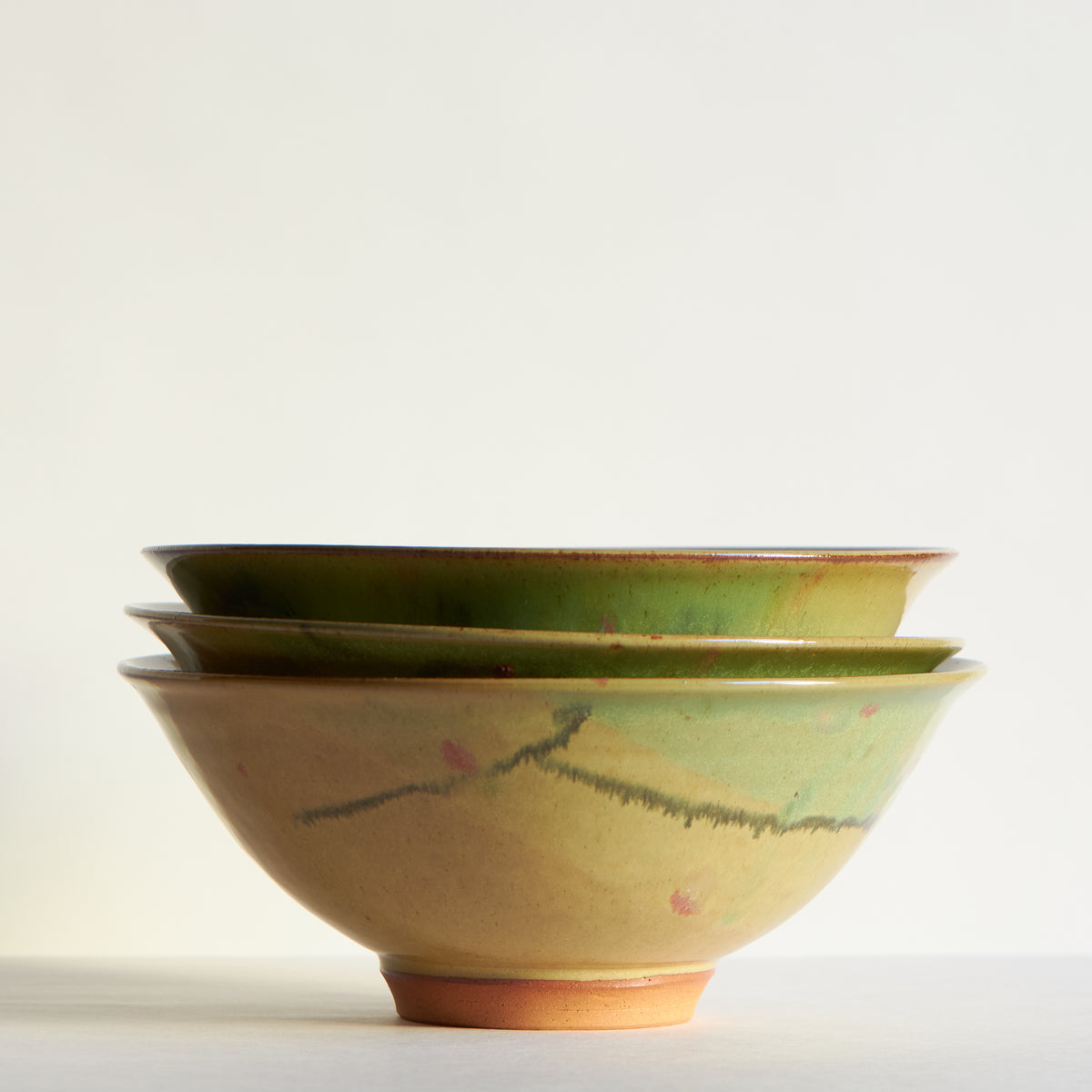
Earthenware is ivory white, beige or brick red. Because it fires at low temperatures, between 950⁰C and 1100⁰C (1,742⁰F and 2,012⁰F), it never vitrifies. Its permeability makes earthenware like terra cotta great garden pots and wonderful for preserving and keeping food cool. Marie Serreau crafts her collection, a tribute to local resources, from Canadian earthenware. She covers it with a glaze, a glass-like coating, to seal it from water for everyday use and for added strength.
At Houmain, we believe that the choice of clay is not about superiority, but intentionality. The ideal material is determined by the desired aesthetic outcome and the functional needs of the final piece.
Sources and Further Readings
- Belleau, Mimi. Technologie des matériaux céramiques. Ateliers d'art de France, 2024.
- Glenn C. Nelson. Universitty of Minnesota, Duluth. Ceramics A Potter's Handbook. Holt, Rinehart and Winston, Inc., 1971.
- Dumont, M. (2008). Clays: Canadian Minerals Yearbook. Natural Resources Canada.
